> ## Documentation Index
> Fetch the complete documentation index at: https://mintlify.com/openai/whisper/llms.txt
> Use this file to discover all available pages before exploring further.
# Performance
> Performance metrics, speed comparisons, and accuracy tradeoffs for Whisper models
## Model Sizes and Speed
Whisper offers six model sizes with different speed and accuracy tradeoffs. Below are the available models and their approximate memory requirements and inference speed relative to the large model.
The relative speeds are measured by transcribing English speech on an A100 GPU. Real-world speed may vary significantly depending on factors including the language, speaking speed, and available hardware.
| Size | Parameters | English-only | Multilingual | Required VRAM | Relative Speed |
| ------ | ---------- | ------------ | ------------ | ------------- | -------------- |
| tiny | 39 M | `tiny.en` | `tiny` | \~1 GB | \~10x |
| base | 74 M | `base.en` | `base` | \~1 GB | \~7x |
| small | 244 M | `small.en` | `small` | \~2 GB | \~4x |
| medium | 769 M | `medium.en` | `medium` | \~5 GB | \~2x |
| large | 1550 M | N/A | `large` | \~10 GB | 1x |
| turbo | 809 M | N/A | `turbo` | \~6 GB | \~8x |
### Model Selection Guidance
**English-only models** (`.en` suffix) tend to perform better for English applications, especially for `tiny.en` and `base.en`. The performance difference becomes less significant for `small.en` and `medium.en`.
**Turbo model** is an optimized version of `large-v3` that offers faster transcription speed with minimal degradation in accuracy. Note that the turbo model is not trained for translation tasks.
## Accuracy by Language
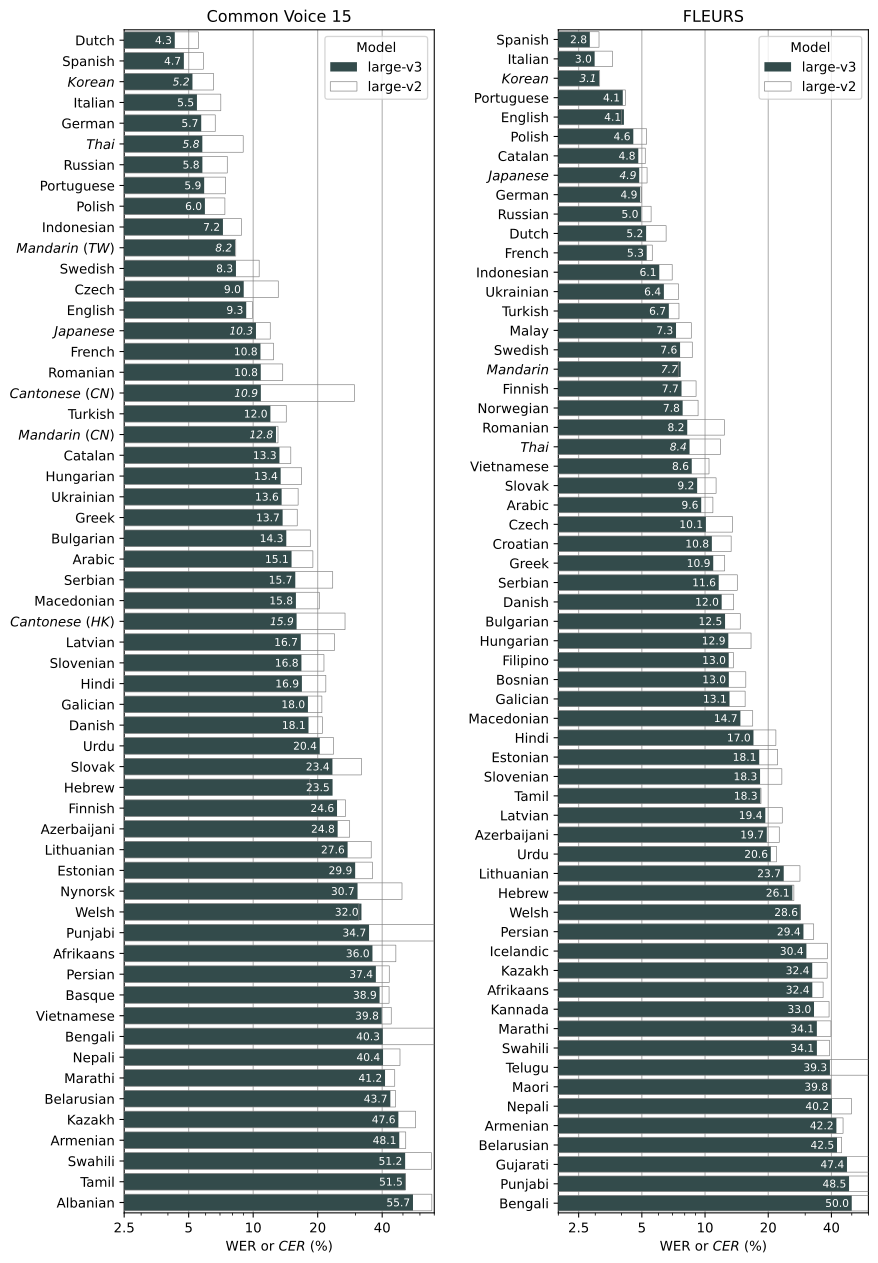
Whisper's performance varies widely depending on the language. The chart below shows a performance breakdown of `large-v3` and `large-v2` models by language, using WER (Word Error Rates) or CER (Character Error Rates, shown in *italic*).
Metrics are evaluated on the Common Voice 15 and Fleurs datasets. Lower WER/CER values indicate better performance.
### Additional Metrics
For comprehensive performance data:
* **WER/CER metrics** for all models and datasets: See Appendix D.1, D.2, and D.4 of [the paper](https://arxiv.org/abs/2212.04356)
* **Translation BLEU scores**: See Appendix D.3 of the paper
## Performance Tradeoffs
### Speed vs Accuracy
* **Fastest**: `tiny` and `turbo` models provide the quickest transcription but with lower accuracy
* **Balanced**: `small` and `medium` models offer good performance for most use cases
* **Most Accurate**: `large` models provide the best accuracy but require more VRAM and processing time
### VRAM Requirements
Minimum VRAM needed for each model:
* **1 GB**: Sufficient for `tiny` and `base` models
* **2 GB**: Required for `small` model
* **5 GB**: Required for `medium` model
* **6 GB**: Required for `turbo` model
* **10 GB**: Required for `large` model
Ensure your GPU has sufficient VRAM before selecting a model. Out-of-memory errors will occur if VRAM is insufficient.
## Language-Specific Performance
Performance is directly correlated with the amount of training data available for each language:
* **High-resource languages** (e.g., English, Spanish, French): Best performance with lower WER
* **Medium-resource languages**: Moderate performance
* **Low-resource languages**: Higher WER and potential accuracy issues
### Training Data Distribution
The models are trained on 680,000 hours of audio:
* **65%** (438,000 hours): English audio with English transcripts
* **18%** (126,000 hours): Non-English audio with English transcripts (translation)
* **17%** (117,000 hours): Non-English audio with native transcripts (98 languages)
## Robustness
Whisper models exhibit improved robustness compared to many existing ASR systems:
* **Accents**: Better handling of diverse accents
* **Background noise**: Improved performance in noisy environments
* **Technical language**: Better recognition of domain-specific terminology
* **Zero-shot translation**: Can translate from multiple languages into English without specific fine-tuning