> ## Documentation Index
> Fetch the complete documentation index at: https://mintlify.com/openai/whisper/llms.txt
> Use this file to discover all available pages before exploring further.
# Overview
> Understanding Whisper's approach to speech recognition
Whisper is a general-purpose speech recognition model trained on a large dataset of diverse audio. It's a multitasking model capable of performing multilingual speech recognition, speech translation, spoken language identification, and voice activity detection.
## Transformer Sequence-to-Sequence Approach
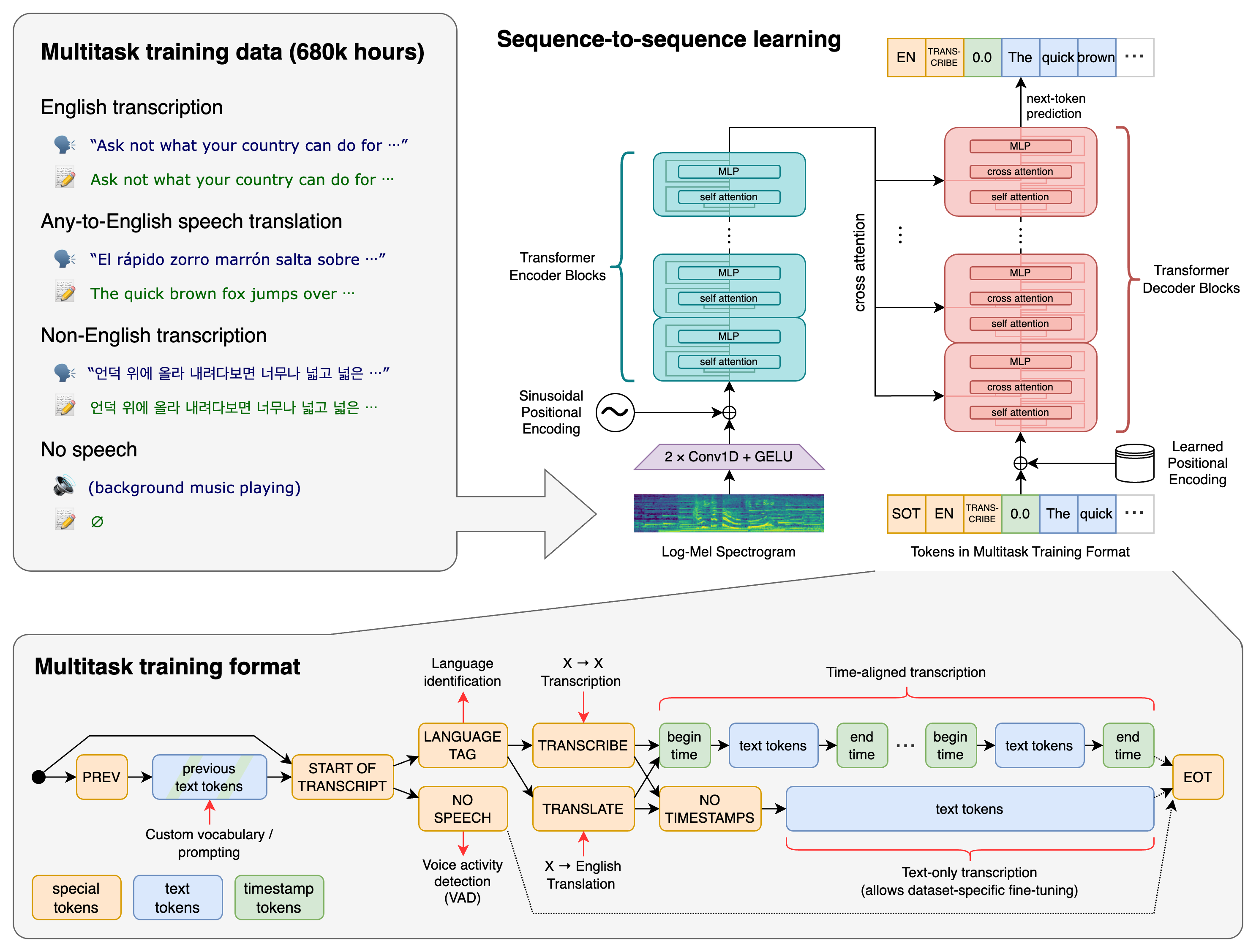
Whisper uses a Transformer sequence-to-sequence model trained on various speech processing tasks. This architecture allows a single model to replace many stages of a traditional speech-processing pipeline.
### Unified Task Representation
All tasks are jointly represented as a sequence of tokens to be predicted by the decoder, including:
* Multilingual speech recognition
* Speech translation
* Spoken language identification
* Voice activity detection
The multitask training format uses a set of special tokens that serve as task specifiers or classification targets, enabling seamless switching between different speech processing tasks.
## Multitask Training
Whisper's training approach combines multiple speech processing tasks into a single model:
Transcribe audio to text in the same language
Translate foreign language speech to English
Identify the spoken language in audio
Detect when speech is present in audio
## How It Works
The transcribe() method processes audio using:
1. **30-second sliding window**: Audio is processed in overlapping segments
2. **Autoregressive predictions**: The model generates text token by token
3. **Special tokens**: Task-specific tokens guide the model's behavior
```python Basic Usage theme={null}
import whisper
model = whisper.load_model("turbo")
result = model.transcribe("audio.mp3")
print(result["text"])
```
```python With Language Detection theme={null}
import whisper
model = whisper.load_model("turbo")
# Load and prepare audio
audio = whisper.load_audio("audio.mp3")
audio = whisper.pad_or_trim(audio)
# Create mel spectrogram
mel = whisper.log_mel_spectrogram(audio, n_mels=model.dims.n_mels).to(model.device)
# Detect language
_, probs = model.detect_language(mel)
print(f"Detected language: {max(probs, key=probs.get)}")
```
## Key Features
Six model sizes available, from tiny (39M parameters) to large (1550M parameters), offering different speed and accuracy tradeoffs.
Whisper supports transcription and translation for 99 languages with varying performance levels.
Specialized English-only variants (`.en` models) for better performance on English audio.
The turbo model offers 8x faster transcription with minimal accuracy loss compared to large-v3.
The turbo model is not trained for translation tasks. Use the multilingual models (tiny, base, small, medium, large) for translation.