> ## Documentation Index
> Fetch the complete documentation index at: https://mintlify.com/openai/whisper/llms.txt
> Use this file to discover all available pages before exploring further.
# Supported Languages
> Languages supported by Whisper and performance characteristics
Whisper supports transcription and translation for 99 languages. Performance varies significantly across languages based on training data availability and linguistic characteristics.
## Complete Language List
Whisper supports the following 99 languages:
* **Afrikaans** (af)
* **Albanian** (sq)
* **Amharic** (am)
* **Arabic** (ar)
* **Armenian** (hy)
* **Assamese** (as)
* **Azerbaijani** (az)
* **Bashkir** (ba)
* **Basque** (eu)
* **Belarusian** (be)
* **Bengali** (bn)
* **Bosnian** (bs)
* **Breton** (br)
* **Bulgarian** (bg)
* **Cantonese** (yue)
* **Catalan** (ca)
* **Chinese** (zh)
* **Croatian** (hr)
* **Czech** (cs)
* **Danish** (da)
* **Dutch** (nl)
* **English** (en)
* **Estonian** (et)
* **Faroese** (fo)
* **Finnish** (fi)
* **French** (fr)
* **Galician** (gl)
* **Georgian** (ka)
* **German** (de)
* **Greek** (el)
* **Gujarati** (gu)
* **Haitian Creole** (ht)
* **Hausa** (ha)
* **Hawaiian** (haw)
* **Hebrew** (he)
* **Hindi** (hi)
* **Hungarian** (hu)
* **Icelandic** (is)
* **Indonesian** (id)
* **Italian** (it)
* **Japanese** (ja)
* **Javanese** (jw)
* **Kannada** (kn)
* **Kazakh** (kk)
* **Khmer** (km)
* **Korean** (ko)
* **Lao** (lo)
* **Latin** (la)
* **Latvian** (lv)
* **Lingala** (ln)
* **Lithuanian** (lt)
* **Luxembourgish** (lb)
* **Macedonian** (mk)
* **Malagasy** (mg)
* **Malay** (ms)
* **Malayalam** (ml)
* **Maltese** (mt)
* **Marathi** (mr)
* **Mongolian** (mn)
* **Myanmar** (my)
* **Maori** (mi)
* **Nepali** (ne)
* **Norwegian** (no)
* **Nynorsk** (nn)
* **Occitan** (oc)
* **Pashto** (ps)
* **Persian** (fa)
* **Polish** (pl)
* **Portuguese** (pt)
* **Punjabi** (pa)
* **Romanian** (ro)
* **Russian** (ru)
* **Sanskrit** (sa)
* **Serbian** (sr)
* **Shona** (sn)
* **Sindhi** (sd)
* **Sinhala** (si)
* **Slovak** (sk)
* **Slovenian** (sl)
* **Somali** (so)
* **Spanish** (es)
* **Sundanese** (su)
* **Swahili** (sw)
* **Swedish** (sv)
* **Tagalog** (tl)
* **Tajik** (tg)
* **Tamil** (ta)
* **Tatar** (tt)
* **Telugu** (te)
* **Thai** (th)
* **Tibetan** (bo)
* **Turkish** (tr)
* **Turkmen** (tk)
* **Ukrainian** (uk)
* **Urdu** (ur)
* **Uzbek** (uz)
* **Vietnamese** (vi)
* **Welsh** (cy)
* **Yiddish** (yi)
* **Yoruba** (yo)
## Language Aliases
Some languages can be specified using alternative names:
| Alias | Language Code |
| :------------------- | :------------------ |
| Burmese | my (Myanmar) |
| Valencian | ca (Catalan) |
| Flemish | nl (Dutch) |
| Haitian | ht (Haitian Creole) |
| Letzeburgesch | lb (Luxembourgish) |
| Pushto | ps (Pashto) |
| Panjabi | pa (Punjabi) |
| Moldavian / Moldovan | ro (Romanian) |
| Sinhalese | si (Sinhala) |
| Castilian | es (Spanish) |
| Mandarin | zh (Chinese) |
## Performance by Language
Whisper's performance varies widely depending on the language. The figure below shows WER (Word Error Rate) or CER (Character Error Rate, in *italic*) for large-v3 and large-v2 models evaluated on Common Voice 15 and Fleurs datasets.
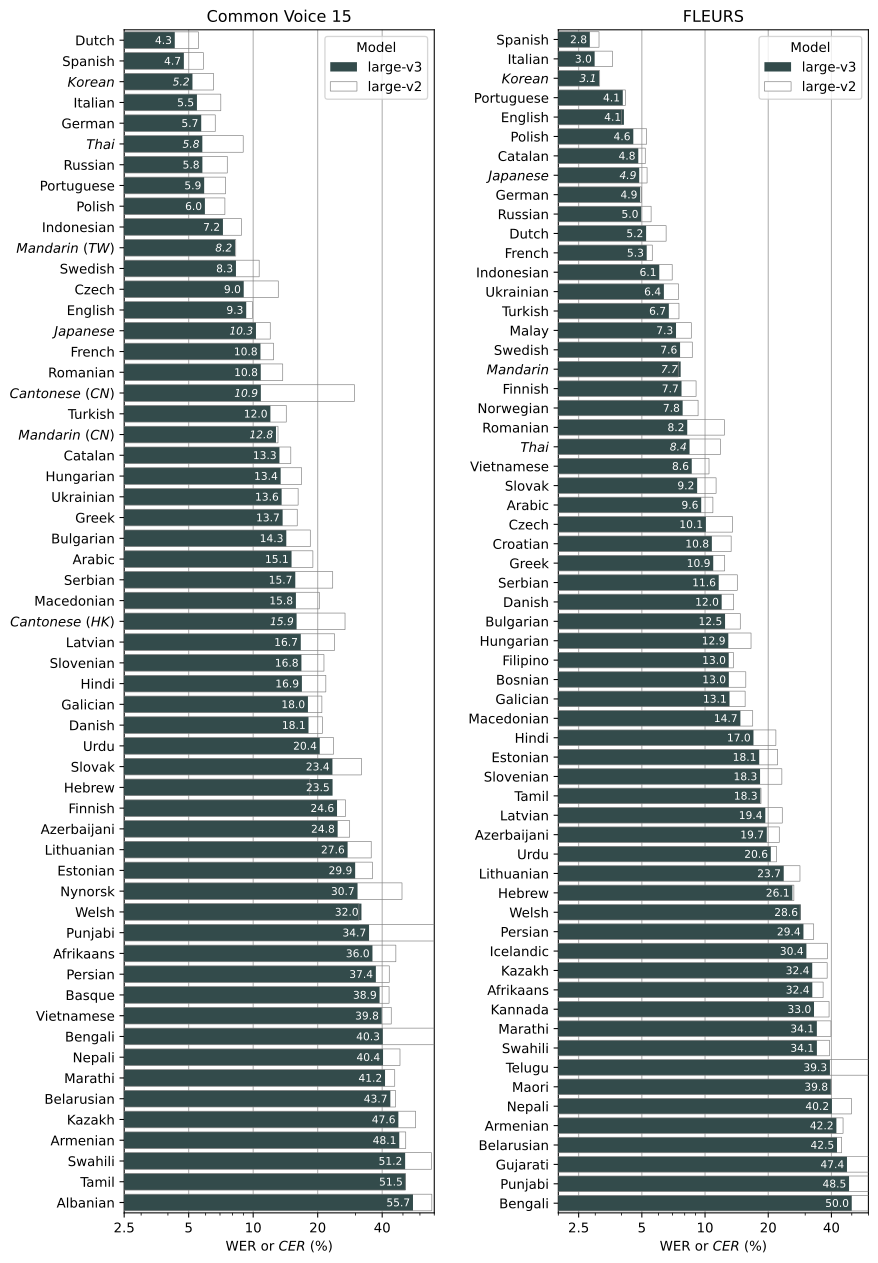
Lower WER/CER values indicate better performance. Additional metrics for other models can be found in Appendix D of the [Whisper paper](https://arxiv.org/abs/2212.04356).
## Using Languages
### Specifying Language in Transcription
```python theme={null}
import whisper
model = whisper.load_model("turbo")
# Transcribe with language specified
result = model.transcribe("audio.mp3", language="Japanese")
print(result["text"])
```
### Command-line Usage
```bash theme={null}
# Transcribe Japanese audio
whisper japanese.wav --language Japanese
# Can use language codes
whisper japanese.wav --language ja
```
### Automatic Language Detection
```python theme={null}
import whisper
model = whisper.load_model("turbo")
# Load audio
audio = whisper.load_audio("audio.mp3")
audio = whisper.pad_or_trim(audio)
# Create mel spectrogram
mel = whisper.log_mel_spectrogram(audio, n_mels=model.dims.n_mels).to(model.device)
# Detect language
_, probs = model.detect_language(mel)
detected_lang = max(probs, key=probs.get)
print(f"Detected language: {detected_lang}")
print(f"Confidence: {probs[detected_lang]:.2%}")
```
### Getting All Language Probabilities
```python theme={null}
import whisper
model = whisper.load_model("turbo")
audio = whisper.load_audio("audio.mp3")
audio = whisper.pad_or_trim(audio)
mel = whisper.log_mel_spectrogram(audio, n_mels=model.dims.n_mels).to(model.device)
_, probs = model.detect_language(mel)
# Show top 5 languages
top_langs = sorted(probs.items(), key=lambda x: x[1], reverse=True)[:5]
for lang, prob in top_langs:
print(f"{lang}: {prob:.2%}")
```
## Translation to English
Translation is only supported **to English**. The turbo model is not trained for translation.
### Translating Non-English Speech
```python theme={null}
import whisper
# Use medium or large for translation
model = whisper.load_model("medium")
result = model.transcribe(
"japanese.wav",
language="Japanese",
task="translate"
)
print(result["text"]) # English translation
```
### Command-line Translation
```bash theme={null}
# Translate Japanese speech to English
whisper japanese.wav --model medium --language Japanese --task translate
```
For best translation results, use the `medium` or `large` models. The `turbo` model will return the original language even if `--task translate` is specified.
## Language-Specific Considerations
### Languages Without Spaces
For languages that don't use spaces (Chinese, Japanese, Thai, Lao, Myanmar, Cantonese), the tokenizer uses special word splitting:
```python theme={null}
# These languages split on unicode points instead of spaces
NO_SPACE_LANGS = {"zh", "ja", "th", "lo", "my", "yue"}
```
### Character-based Metrics
Some languages use Character Error Rate (CER) instead of Word Error Rate (WER) for evaluation:
* Chinese (zh)
* Japanese (ja)
* Thai (th)
* And other languages shown in *italic* in the performance chart
## Best Practices
English, Spanish, French, German, Chinese, and other widely-spoken languages generally have the best performance.
Less common languages may have higher error rates. Consider using larger models for better accuracy.
If unsure of the language, use automatic detection. It's reliable for most well-represented languages.
Use larger models (medium, large) for better performance on challenging languages or translation tasks.
## Checking Language Support
```python theme={null}
from whisper.tokenizer import LANGUAGES, TO_LANGUAGE_CODE
# Get all supported languages
print(f"Total languages: {len(LANGUAGES)}")
# Check if a language is supported
if "ja" in LANGUAGES:
print(f"Japanese: {LANGUAGES['ja']}")
# Look up language code by name
if "french" in TO_LANGUAGE_CODE:
print(f"French code: {TO_LANGUAGE_CODE['french']}")
# List all languages
for code, name in LANGUAGES.items():
print(f"{code}: {name}")
```